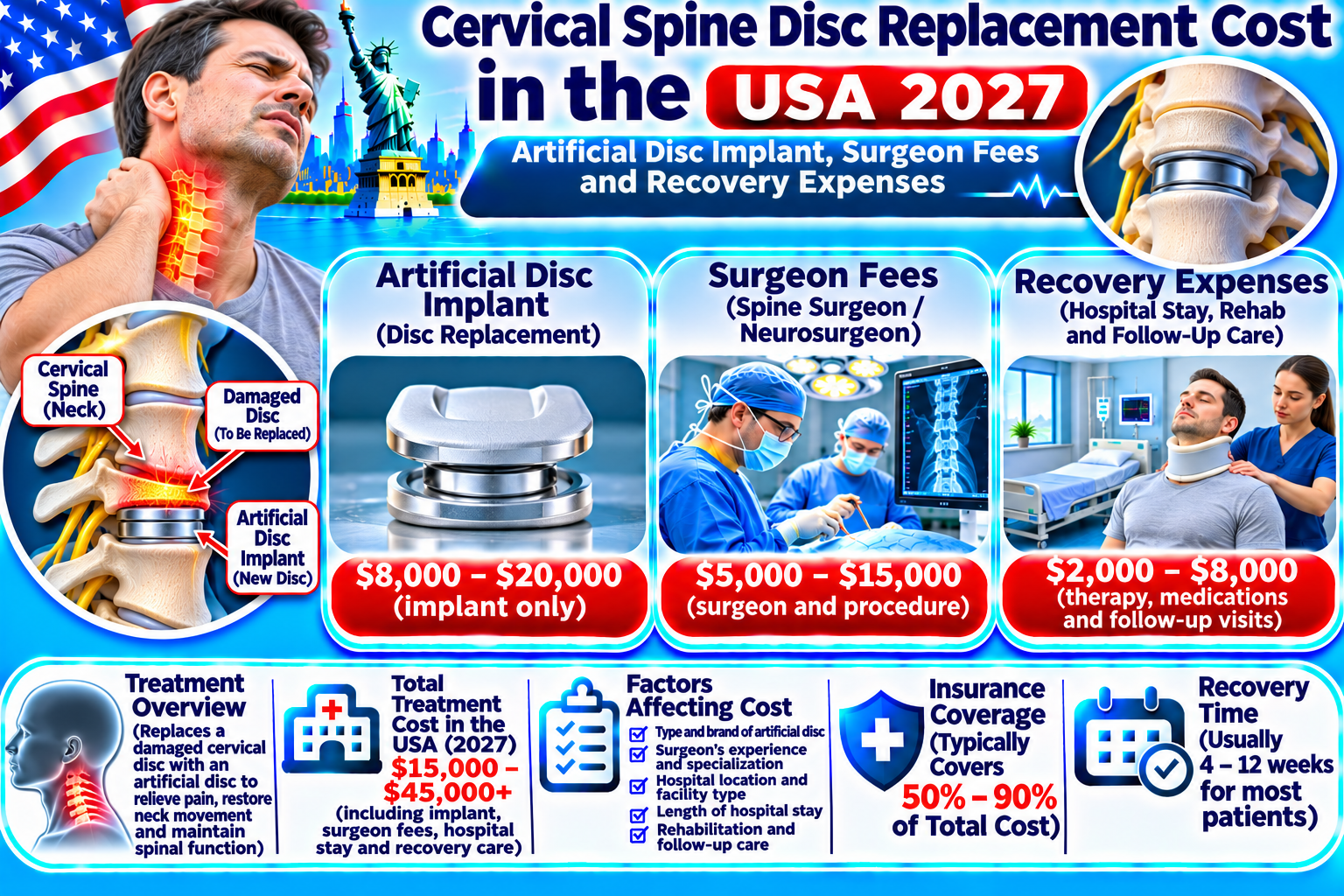
Cervical spine disc replacement is an advanced surgical procedure designed to treat selected neck conditions caused by damaged or degenerating spinal discs. The operation involves removing a diseased cervical disc and replacing it with an artificial implant that helps preserve movement between the affected vertebrae.
Understanding cervical spine disc replacement costs in the USA in 2027 is important for patients comparing artificial disc implant prices, orthopedic spine surgeon fees, neurosurgeon charges, hospital bills, anesthesia expenses, and postoperative rehabilitation costs.
The total expense depends on the number of discs replaced, implant technology, surgical complexity, healthcare facility, geographic location, and insurance benefits. Some patients qualify for outpatient surgery, while others require overnight hospital monitoring.
This comprehensive guide explains estimated American cervical disc replacement expenses for 2027, including single-level and two-level surgery, artificial disc technology, Medicare coverage, recovery timelines, and financial planning strategies.
What Is Cervical Spine Disc Replacement?
Cervical disc replacement, also called cervical disc arthroplasty or artificial cervical disc replacement, is a surgical procedure that replaces a damaged spinal disc in the neck with a prosthetic device.
The cervical spine consists of seven vertebrae, identified as C1 through C7. Intervertebral discs between most adjacent vertebrae provide cushioning and help support neck movement.
When a disc degenerates or herniates, it may compress nearby nerves or the spinal cord, causing pain, numbness, weakness, or neurological problems.
Artificial disc replacement aims to relieve pressure on affected structures while maintaining motion at the treated spinal level.
However, not every patient with neck pain or disc degeneration is a suitable candidate for this operation.
Common Reasons for Cervical Disc Replacement
Cervical Degenerative Disc Disease
Degenerative disc disease develops when spinal discs lose hydration, flexibility, or structural integrity over time.
In some patients, degeneration contributes to nerve compression and persistent symptoms that do not improve with appropriate conservative treatment.
Cervical Disc Herniation
A herniated disc occurs when disc material extends beyond its normal boundaries and may press against a nearby nerve root or the spinal cord.
Surgery may be considered when neurological symptoms are significant or persist despite nonsurgical treatment.
Cervical Radiculopathy
Cervical radiculopathy occurs when a nerve root in the neck becomes irritated or compressed.
Symptoms may include pain traveling into the shoulder or arm, tingling, numbness, and muscle weakness.
Cervical Myelopathy
Cervical myelopathy develops when the spinal cord is compressed.
Possible symptoms include hand clumsiness, difficulty walking, balance problems, and progressive neurological impairment.
Suspected myelopathy requires timely specialist evaluation because worsening spinal cord compression can cause lasting disability.
Symptoms That May Require Spine Evaluation
Common symptoms associated with cervical disc disorders include:
- Persistent neck pain.
- Pain radiating into the shoulders or arms.
- Tingling or numbness in the hands.
- Weakness in the arms or fingers.
- Reduced neck movement.
- Difficulty performing everyday activities.
- Loss of hand coordination.
- Balance or walking difficulties.
Rapidly worsening weakness, new difficulty walking, or new bladder or bowel dysfunction requires urgent medical evaluation.
How Are Cervical Disc Problems Diagnosed?
A spine specialist reviews the patient’s symptoms, medical history, neurological examination, and imaging findings.
Common diagnostic services include:
- Physical and neurological examination.
- Cervical spine X-rays.
- Magnetic resonance imaging (MRI).
- CT scanning when necessary.
- Flexion-extension X-rays to assess instability.
- Electromyography or nerve conduction testing in selected cases.
- Bone density evaluation when clinically indicated.
MRI is particularly useful for identifying disc herniation, nerve compression, and spinal cord abnormalities.
Imaging findings must be interpreted alongside symptoms because degenerative changes are common even in people without significant neck pain.
Who Is a Candidate for Artificial Cervical Disc Replacement?
Cervical disc replacement is generally considered for carefully selected adults with symptomatic cervical disc disease and corresponding nerve root or spinal cord compression.
Appropriate candidates often have one or two affected disc levels and have not improved with suitable nonsurgical treatment, unless neurological deterioration requires earlier intervention.
Factors that may make disc replacement unsuitable include:
- Severe spinal instability.
- Advanced facet joint arthritis.
- Significant osteoporosis.
- Active infection.
- Major spinal deformity.
- Certain implant material allergies.
- Extensive multilevel degeneration.
Eligibility also depends on the specific artificial disc’s FDA-approved indications and the patient’s medical circumstances.
Types of Cervical Disc Replacement Surgery
Single-Level Cervical Disc Replacement
Single-level surgery replaces one damaged cervical disc with an artificial implant.
It is commonly performed when one disc level is responsible for nerve compression or related neurological symptoms.
Compared with multilevel surgery, single-level replacement generally requires fewer implants and may involve a shorter operation.
Two-Level Cervical Disc Replacement
Two-level surgery replaces discs at two adjacent cervical levels when the patient meets appropriate clinical and device-specific requirements.
This procedure requires additional implant materials, surgical preparation, and postoperative assessment.
Two-level surgery may cost more than single-level replacement because of the additional implant and procedural complexity.
Motion-Preserving Artificial Disc Technology
Artificial cervical discs are designed to maintain movement between treated vertebrae.
Different devices use metal, polymer, or combined materials and have varying design characteristics.
The surgeon selects an appropriate implant according to anatomy, medical indications, device labeling, and clinical experience.
How Is Cervical Disc Replacement Performed?
The procedure is generally performed under general anesthesia.
The surgeon makes an incision in the front of the neck and carefully approaches the affected cervical disc.
The damaged disc is removed, and pressure on the nerve roots or spinal cord is relieved.
An artificial disc implant is then positioned between the vertebrae using specialized instruments and imaging guidance.
The surgeon checks implant placement before closing the incision.
Patients are monitored after surgery and may return home the same day or remain overnight, depending on their condition and facility practices.
Cervical Spine Disc Replacement Cost in the USA in 2027
American cervical disc replacement expenses vary significantly between hospitals, ambulatory surgery centers, insurance companies, and surgical teams.
Published outpatient cash-price examples in the United States have ranged from approximately $24,000 to more than $34,000 for particular bundled procedures, while other published national estimates are considerably higher.
The following figures are illustrative 2027 financial planning ranges rather than verified national averages, guaranteed quotations, or actual insurance reimbursement amounts.
Estimated USA Cost Breakdown
| Treatment or Service | Estimated Cost (USD) |
|---|---|
| Initial Spine Specialist Consultation | $200–$600+ |
| Cervical Spine X-Rays | $100–$500+ |
| Cervical Spine MRI | $500–$3,000+ |
| Artificial Cervical Disc Implant | $4,000–$12,000+ per device as a cost component |
| Single-Level Disc Replacement Episode | $25,000–$60,000+ |
| Two-Level Disc Replacement Episode | $40,000–$85,000+ |
| Spine Surgeon Professional Fee | $3,000–$10,000+ if separately billed |
| Anesthesia Professional Fee | $800–$3,000+ if separately billed |
| Physical Therapy Session | $100–$300+ per session |
| Postoperative Medication | $30–$300+ depending on prescription |
| Follow-Up Spine Consultation | $100–$400+ |
| Complex Revision Surgery | $40,000–$100,000+ |
Important: These broad hypothetical ranges are intended only for preliminary budgeting. Surgical episode estimates may already include the implant, surgeon, hospital, anesthesia, and recovery room charges. Do not add individual components without checking for overlap.
USA Cervical Disc Replacement Cost Comparison
Because this article focuses on the United States, the following table compares American treatment scenarios rather than different countries.
| USA Treatment Scenario | Illustrative Overall Budget |
|---|---|
| Single-Level Artificial Disc Replacement | $25,000–$60,000+ |
| Two-Level Artificial Disc Replacement | $40,000–$85,000+ |
| Single-Level Surgery With Additional Rehabilitation | $27,000–$65,000+ |
| Complex Disc Replacement or Revision | $40,000–$100,000+ |
These scenarios reflect different treatment requirements and are not interchangeable options based on price alone.
Artificial Cervical Disc Implant Prices
The artificial disc implant is an important component of cervical spine replacement surgery. Device costs depend on implant design, materials, manufacturer agreements, and hospital purchasing contracts.
Modern cervical implants are engineered to provide structural support while allowing controlled movement at the treated spinal level.
Some devices use metal-on-metal components, while others incorporate polymer materials. Different designs have specific indications and limitations.
Patients should understand that the hospital’s device acquisition cost may differ substantially from the amount billed to an insurance company.
When reviewing a surgical estimate, ask whether the implant price is included in the complete procedure package.
Orthopedic Spine Surgeon and Neurosurgeon Fees
Cervical disc replacement may be performed by an appropriately trained orthopedic spine surgeon or neurosurgeon.
Professional fees depend on the complexity of the operation, number of treated levels, geographic location, and insurance contracts.
Surgeon fees may include preoperative planning, the surgical procedure, and certain postoperative appointments.
Some facilities bill professional and hospital services separately. Patients should confirm which services are included in their estimate.
Hospital vs Ambulatory Surgery Center Costs
Cervical disc replacement may be performed in a hospital outpatient department or an ambulatory surgery center when clinically appropriate.
Ambulatory centers sometimes offer lower bundled prices because they have different facility operating costs.
Published Medicare payment comparisons have shown higher facility payments for certain cervical disc replacement procedures in hospital outpatient departments than in ambulatory surgery centers.
However, patients with complex medical conditions may require hospital resources that are not available in every outpatient facility.
Cervical Disc Replacement vs Spinal Fusion Cost
Anterior cervical discectomy and fusion, commonly called ACDF, is another surgical treatment for selected cervical disc conditions.
Fusion removes the damaged disc and stabilizes the affected spinal level, while artificial disc replacement aims to preserve motion.
Artificial disc replacement may involve higher implant or facility costs in some settings.
However, the long-term financial comparison depends on recovery, complications, subsequent procedures, and individual outcomes.
Neither operation is universally superior. The appropriate procedure depends on spinal anatomy, neurological findings, and clinical suitability.
Cervical Disc Replacement With Health Insurance
Many comprehensive American health insurance plans cover medically necessary cervical disc replacement when applicable clinical requirements are met.
Coverage often depends on imaging findings, documented symptoms, previous nonsurgical treatment, and the specific artificial disc selected.
Important insurance considerations include:
- Annual deductible and out-of-pocket maximum.
- Spine surgeon and hospital network participation.
- Prior authorization for the planned operation.
- Coverage for the selected artificial disc implant.
- Single-level versus two-level procedure benefits.
- Anesthesia and surgical facility coverage.
- Physical therapy and rehabilitation benefits.
- Postoperative imaging and specialist visits.
Insurance approval does not necessarily eliminate patient expenses. Copayments, coinsurance, and deductibles may still apply.
Medicare Coverage for Cervical Disc Replacement
Original Medicare may cover medically necessary cervical disc replacement when applicable coverage criteria are satisfied.
Medicare coverage can depend on local coverage determinations, the specific implant, documented nerve or spinal cord compression, and the patient’s clinical history.
Some Medicare coverage policies permit selected single-level procedures and qualifying two-level procedures using appropriately approved devices.
Medicare Part A generally applies to qualifying inpatient admissions, while Part B commonly covers eligible outpatient procedures and physician services.
Medicare Advantage plans may have different authorization requirements, provider networks, and cost-sharing arrangements.
Medicaid and Financial Assistance
Medicaid may cover medically necessary cervical spine surgery for eligible individuals, depending on state-specific benefits and coverage policies.
Some nonprofit hospitals offer financial assistance programs for qualifying patients.
Patients can ask hospital financial counselors about payment arrangements and available assistance before scheduled surgery.
Cervical Disc Replacement Without Insurance
Uninsured patients may face substantial expenses for imaging, artificial implants, surgery, anesthesia, and rehabilitation.
Before accepting a planned surgical quotation, patients should ask:
- Is the artificial disc implant included?
- Are surgeon and anesthesia fees covered?
- Does the estimate include operating room services?
- Will postoperative imaging be billed separately?
- Are overnight hospital charges included?
- How many follow-up appointments are covered?
- What rehabilitation expenses should be expected?
Written estimates should identify included services, exclusions, and possible additional charges.
Factors Influencing Cervical Disc Replacement Prices
1. Number of Disc Levels
Two-level surgery usually requires additional implants and surgical resources compared with a single-level procedure.
2. Artificial Disc Technology
Different implant designs, materials, and manufacturer contracts influence device-related expenses.
3. Surgeon and Hospital Fees
Professional services, operating room time, staffing, and facility charges contribute to total costs.
4. Insurance Coverage
Deductibles, negotiated rates, prior authorization, and provider networks affect personal financial responsibility.
5. Geographic Location
Healthcare prices vary across American cities and states because of regional operating expenses and insurance contracts.
6. Medications and Rehabilitation
Pain medications, physical therapy, postoperative imaging, and follow-up appointments can increase recovery expenses.
7. Complications and Additional Procedures
Unexpected complications or revision surgery may substantially increase long-term medical spending.
Recovery After Cervical Disc Replacement Surgery
Recovery depends on the number of treated levels, underlying neurological condition, overall health, and surgeon’s instructions.
Many patients resume light daily activities relatively soon after uncomplicated surgery.
Some individuals return to light activities within several weeks, while full recovery and unrestricted activity may take longer.
Patients should follow individualized guidance regarding lifting, driving, exercise, wound care, and return to work.
Recovery timelines should not be used as guarantees because healing varies between patients.
Physical Therapy and Rehabilitation Expenses
Physical therapy may be recommended after cervical disc replacement to improve strength, posture, and functional movement.
The need for rehabilitation depends on the surgical outcome and individual recovery.
Patients may require several therapy sessions, creating additional expenses beyond the original surgical bill.
Insurance coverage for physical therapy varies according to plan benefits, medical necessity, and provider network requirements.
Possible Complications and Additional Costs
Cervical disc replacement carries potential risks, including infection, bleeding, swallowing difficulty, hoarseness, nerve injury, and persistent pain.
Additional complications may include implant displacement, abnormal bone formation around the artificial disc, or the need for revision surgery.
Unexpected complications can increase hospitalization, imaging, medication, and rehabilitation costs.
Patients should discuss procedure-specific risks and expected benefits with their spine surgeon.
Long-Term Follow-Up Expenses
After cervical disc replacement, patients may require follow-up examinations and imaging to evaluate implant position and spinal movement.
Some individuals need additional treatment for persistent symptoms or degenerative changes at other spinal levels.
Long-term financial planning should account for follow-up appointments, possible rehabilitation, and treatment of unrelated spinal conditions.
How to Reduce Cervical Disc Replacement Costs
- Verify insurance benefits before planned surgery.
- Request a complete written surgical estimate.
- Confirm surgeon and facility network participation.
- Ask whether the artificial disc implant is included.
- Compare medically appropriate surgical facilities.
- Review physical therapy coverage.
- Explore hospital financial assistance programs.
- Follow postoperative instructions to support recovery.
The least expensive surgical option is not necessarily the safest or most appropriate treatment. Medical suitability and surgeon expertise should remain priorities.
Frequently Asked Questions
How much does cervical disc replacement cost in the USA in 2027?
Illustrative surgical expenses may range from approximately $25,000 to $60,000 or more for single-level cervical disc replacement. Two-level procedures may cost approximately $40,000 to $85,000 or more.
Does insurance cover artificial cervical disc replacement?
Many comprehensive insurance plans cover qualifying medically necessary procedures, subject to clinical criteria, authorization requirements, and patient cost-sharing.
Does Medicare cover cervical disc replacement?
Medicare may cover qualifying procedures when applicable coverage requirements and device-specific criteria are satisfied.
Is artificial disc replacement better than spinal fusion?
Both procedures can be effective for selected patients. Artificial disc replacement preserves motion, while fusion stabilizes the treated spinal level. The best choice depends on individual anatomy and medical needs.
How long does cervical disc replacement recovery take?
Many patients resume light activities within several weeks, but full recovery may take several months depending on the operation and individual circumstances.
Can an artificial cervical disc fail?
Yes. Implant-related complications can occur, although many patients experience long-term symptom improvement. Regular follow-up helps monitor outcomes.
Are physical therapy costs included in surgery?
Not always. Rehabilitation may be billed separately, depending on the hospital package and insurance policy.
Conclusion
Cervical spine disc replacement costs in the USA in 2027 depend on artificial disc implant technology, spine surgeon fees, hospital expenses, anesthesia, surgical complexity, rehabilitation, and insurance coverage.
Patients should compare complete treatment estimates, verify insurance benefits, and consult an experienced spine specialist to determine whether artificial cervical disc replacement is appropriate.
Accurate diagnosis, careful patient selection, and consistent postoperative care are essential for achieving favorable outcomes and managing long-term healthcare expenses.
Medical Disclaimer: This article provides general educational and financial planning information only. It does not replace professional medical advice, diagnosis, or treatment. All 2027 prices are illustrative estimates and should be verified directly with healthcare providers, hospitals, implant suppliers, and insurance companies.
