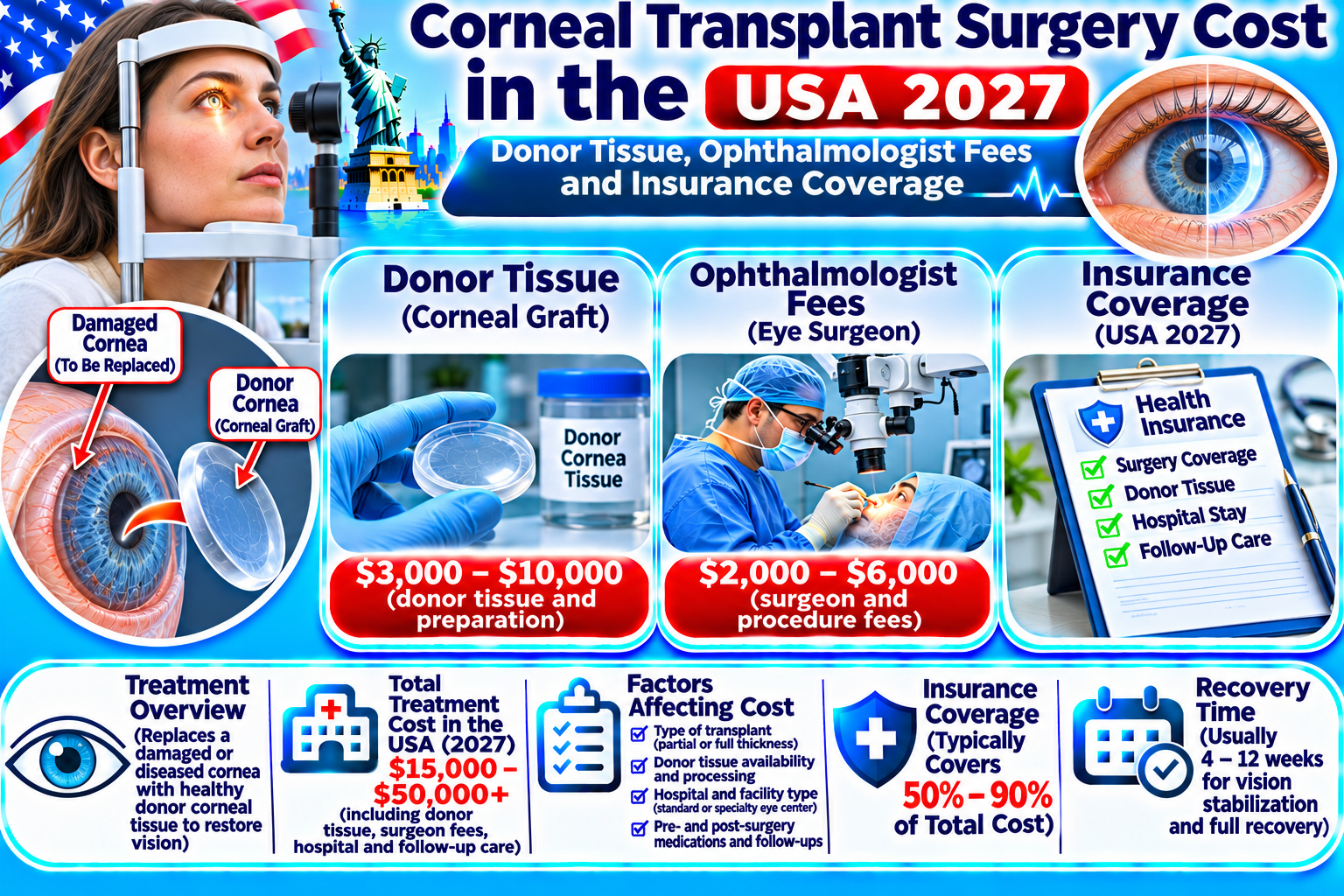
Corneal transplant surgery is an important ophthalmic procedure used to replace damaged or diseased corneal tissue with healthy donor tissue. The cornea is the transparent outer surface of the eye that helps focus light and protect internal eye structures. When the cornea becomes cloudy, scarred, swollen, or structurally weakened, vision may deteriorate significantly.
Understanding corneal transplant surgery costs in the USA in 2027 is essential for patients comparing donor tissue expenses, ophthalmologist fees, surgical facility charges, anesthesia, and health insurance coverage. Treatment costs vary depending on the type of transplant, eye condition, hospital location, insurance benefits, and postoperative requirements.
Modern corneal transplantation includes full-thickness and partial-thickness procedures. Some patients require replacement of the entire cornea, while others need only a specific damaged layer.
This comprehensive guide explains estimated American corneal transplant expenses for 2027, including penetrating keratoplasty, endothelial keratoplasty, donor tissue processing, Medicare coverage, recovery, and long-term follow-up care.
What Is a Corneal Transplant?
A corneal transplant, also called keratoplasty, is a surgical procedure that replaces diseased corneal tissue with healthy tissue obtained from a human donor.
The cornea contains several specialized layers that work together to maintain transparency and proper vision.
Damage to these layers can cause blurred vision, glare, pain, swelling, and permanent visual impairment.
Depending on the diagnosis, an ophthalmologist may recommend replacing the full corneal thickness or only the affected layers.
Corneal transplantation is generally considered when medications, contact lenses, or other treatments cannot adequately manage the condition.
Common Reasons for Corneal Transplant Surgery
Fuchs Endothelial Dystrophy
Fuchs endothelial dystrophy damages the cells responsible for maintaining proper fluid balance in the cornea. Progressive swelling can cause blurred vision and discomfort.
Selected patients may benefit from endothelial keratoplasty.
Keratoconus
Keratoconus causes progressive thinning and irregular curvature of the cornea.
Many patients can be managed with specialized contact lenses or corneal cross-linking, but advanced disease or significant scarring may require transplantation.
Corneal Scarring
Scarring may develop after infections, injuries, or previous eye surgery. Severe scars can interfere with light transmission and reduce vision.
Corneal Edema
Persistent corneal swelling may occur when endothelial cells no longer function adequately.
Endothelial transplantation can restore corneal clarity in appropriately selected cases.
Previous Transplant Failure
Some patients require another corneal transplant when an earlier graft fails because of rejection, cell loss, infection, or other complications.
Symptoms of Corneal Disease
Corneal disorders can cause different symptoms depending on the affected tissue and severity.
- Persistent blurred or cloudy vision.
- Increased sensitivity to light.
- Glare and halos around lights.
- Eye pain or irritation.
- Reduced visual clarity despite corrective lenses.
- Corneal swelling.
- Visible cloudiness or scarring.
- Progressive difficulty performing daily activities.
Sudden vision loss, severe eye pain, or significant redness requires urgent ophthalmic evaluation.
How Is Corneal Disease Diagnosed?
An ophthalmologist evaluates the cornea using specialized examinations to determine the cause of visual impairment.
Common diagnostic procedures include:
- Comprehensive dilated eye examination.
- Slit-lamp examination.
- Corneal topography or tomography.
- Pachymetry to measure corneal thickness.
- Specular microscopy to assess endothelial cells.
- Visual acuity and refraction testing.
- Additional imaging when clinically necessary.
Not every patient requires every test. The examination findings help determine whether transplantation is appropriate.
Types of Corneal Transplant Surgery
Penetrating Keratoplasty (PK)
Penetrating keratoplasty is a full-thickness corneal transplant. The surgeon removes a circular section of the damaged cornea and replaces it with donor tissue.
Fine sutures are commonly used to secure the graft.
PK may be recommended for advanced corneal scarring, extensive tissue damage, or diseases affecting multiple corneal layers.
Descemet Stripping Endothelial Keratoplasty (DSEK or DSAEK)
DSAEK replaces the damaged endothelial layer along with a thin layer of supporting donor tissue.
It is commonly used for conditions such as Fuchs endothelial dystrophy and certain cases of corneal edema.
Compared with full-thickness transplantation, endothelial keratoplasty may offer faster visual rehabilitation in appropriately selected patients.
Descemet Membrane Endothelial Keratoplasty (DMEK)
DMEK transplants an extremely thin donor tissue layer containing Descemet membrane and endothelial cells.
The technique can provide excellent visual outcomes for suitable patients but requires specialized surgical expertise and careful postoperative positioning.
Deep Anterior Lamellar Keratoplasty (DALK)
DALK replaces the front layers of the cornea while preserving the patient’s healthy endothelium.
It may be appropriate for certain patients with keratoconus or anterior corneal scarring.
How Is Corneal Transplant Surgery Performed?
Corneal transplantation is commonly performed in a hospital outpatient department or ambulatory surgery center.
The patient receives local or general anesthesia depending on the procedure, medical condition, and surgeon’s recommendations.
The ophthalmologist removes the affected corneal tissue and places the prepared donor graft.
Some procedures require sutures, while endothelial grafts are often supported by an air or gas bubble inside the eye.
Patients usually receive postoperative eye drops and detailed instructions to protect the graft during healing.
Corneal Transplant Surgery Cost in the USA in 2027
American corneal transplant costs vary according to transplant technique, donor tissue preparation, surgical facility, ophthalmologist fees, and postoperative treatment.
Donor tissue is typically obtained and processed through an eye bank. Processing, testing, storage, and distribution contribute to tissue-related expenses.
The following figures are illustrative 2027 financial planning ranges rather than verified national averages, guaranteed cash prices, or actual insurance reimbursement amounts.
Estimated USA Cost Breakdown
| Treatment or Service | Estimated Cost (USD) |
|---|---|
| Ophthalmologist Consultation | $150–$500+ |
| Corneal Imaging and Diagnostic Tests | $200–$1,200+ |
| Donor Corneal Tissue and Eye Bank Processing | $2,000–$6,000+ as a cost component |
| Penetrating Keratoplasty (PK) | $12,000–$30,000+ |
| DSAEK Corneal Transplant | $10,000–$25,000+ |
| DMEK Corneal Transplant | $12,000–$28,000+ |
| DALK Corneal Transplant | $12,000–$30,000+ |
| Ophthalmic Surgeon Fee | $1,500–$5,000+ if separately billed |
| Anesthesia Professional Fee | $500–$2,000+ if separately billed |
| Postoperative Eye Medications | $50–$400+ per month |
| Follow-Up Ophthalmology Visit | $100–$400+ |
Important: These broad hypothetical ranges are intended only for preliminary budgeting. Transplant episode prices may already include donor tissue, surgeon, facility, and anesthesia charges. Separate items should not be added without confirming what is included.
USA Corneal Transplant Cost Comparison
Because this article focuses on the United States, the following table compares American transplant techniques rather than different countries.
| USA Treatment Scenario | Illustrative Overall Budget |
|---|---|
| Full-Thickness Corneal Transplant | $12,000–$30,000+ |
| DSAEK Endothelial Transplant | $10,000–$25,000+ |
| DMEK Endothelial Transplant | $12,000–$28,000+ |
| DALK Partial-Thickness Transplant | $12,000–$30,000+ |
| Complex Repeat Transplant | $15,000–$40,000+ |
These procedures treat different corneal conditions. The most appropriate technique depends on the affected layers, eye health, and surgeon’s clinical assessment.
Donor Corneal Tissue and Eye Bank Fees
Donor tissue is an essential component of most corneal transplant procedures. Eye banks collect, evaluate, preserve, prepare, and distribute donated corneal tissue according to medical standards.
Although the tissue itself is donated, eye banks may charge for services associated with its preparation and delivery.
These charges may include infectious disease testing, tissue evaluation, preservation, specialized preparation, and transportation.
Patients should ask whether the surgical quotation includes the eye bank’s tissue processing fee or whether it will appear separately on the bill.
Ophthalmologist and Corneal Surgeon Fees
Corneal transplantation is generally performed by an ophthalmologist with specialized training in corneal diseases and surgery.
Professional fees depend on the procedure, complexity, geographic location, and insurance arrangements.
Patients may also receive separate bills for diagnostic examinations, anesthesia, postoperative evaluations, or additional procedures.
Hospital vs Ambulatory Surgery Center Costs
Corneal transplantation is frequently performed as outpatient surgery. The choice of facility can influence overall expenses.
Ambulatory surgery centers may have lower facility charges than hospital outpatient departments for comparable procedures.
For example, Medicare’s 2026 procedure lookup lists an average Medicare-approved amount of approximately $3,855 for one type of penetrating keratoplasty in an ambulatory surgery center and $6,505 in a hospital outpatient department.
These figures apply to a specific procedure code and do not represent the complete cost of every transplant. Donor tissue and additional services may be billed separately.
Corneal Transplant Surgery With Health Insurance
Many comprehensive American health insurance plans cover medically necessary corneal transplantation when applicable clinical requirements are met.
However, coverage does not necessarily eliminate patient expenses.
Important insurance considerations include:
- Annual deductible and out-of-pocket maximum.
- Ophthalmologist and surgical facility network participation.
- Prior authorization for planned transplantation.
- Coverage for donor tissue processing.
- Anesthesia and surgical facility benefits.
- Prescription eye drop coverage.
- Postoperative examination benefits.
- Coverage for additional procedures if complications occur.
Patients should request a personalized insurance estimate before scheduled surgery.
Medicare Coverage for Corneal Transplant Surgery
Original Medicare may cover medically necessary corneal transplantation under Medicare Part B when applicable requirements are satisfied.
After the Part B deductible is met, patients generally pay 20 percent of the Medicare-approved amount for covered Part B services, unless supplemental coverage changes their responsibility.
Medicare’s 2026 price lookup provides examples of approximately $770 in patient cost-sharing at an ambulatory surgery center and $1,300 at a hospital outpatient department for a specified penetrating keratoplasty procedure.
Actual expenses may differ because of additional services, donor tissue charges, individual circumstances, and supplemental insurance.
Medicare Advantage plans may have different provider networks, authorization requirements, and cost-sharing arrangements.
Medicaid and Financial Assistance
Medicaid may cover medically necessary corneal transplantation for eligible individuals, depending on state-specific benefits and requirements.
Some nonprofit hospitals offer financial assistance programs. Patients can ask hospital financial counselors about eligibility, payment arrangements, and available support.
Corneal Transplant Surgery Without Insurance
Uninsured patients may face substantial expenses for donor tissue, surgery, anesthesia, and follow-up care.
Before accepting a planned surgical quotation, patients should ask:
- Is donor tissue processing included?
- Are surgeon and anesthesia fees included?
- Does the estimate cover the surgical facility?
- Will diagnostic imaging be billed separately?
- Are postoperative eye drops included?
- How many follow-up visits are expected?
- What happens if another procedure becomes necessary?
Obtaining a complete written estimate can help patients understand potential financial responsibilities.
Factors Influencing Corneal Transplant Prices
1. Type of Transplant
Full-thickness and partial-thickness procedures require different surgical techniques, equipment, and donor tissue preparation.
2. Donor Tissue Processing
Eye bank testing, preservation, preparation, and transportation contribute to transplant-related expenses.
3. Hospital and Facility Charges
Operating room resources, anesthesia, surgical supplies, and recovery monitoring influence the final bill.
4. Insurance Coverage
Deductibles, coinsurance, negotiated rates, and provider network participation affect personal financial responsibility.
5. Geographic Location
Healthcare prices vary across American cities and states because of regional operating costs and insurance contracts.
6. Medication Requirements
Postoperative steroid eye drops, antibiotics, and other prescribed medications may create ongoing expenses.
7. Complications and Repeat Procedures
Graft rejection, infection, or additional surgical treatment may increase long-term healthcare spending.
Recovery After Corneal Transplant Surgery
Recovery depends on the transplant technique, underlying eye condition, and individual healing response.
Patients undergoing endothelial keratoplasty may experience visual improvement sooner than those recovering from full-thickness transplantation.
Penetrating keratoplasty can require a prolonged healing period, sometimes lasting many months or longer.
Patients should follow instructions regarding eye protection, prescribed drops, activity restrictions, and postoperative appointments.
Possible Complications and Additional Costs
Corneal transplantation carries potential risks, including graft rejection, infection, increased eye pressure, and persistent visual problems.
Some endothelial grafts require an additional procedure to reposition or reattach donor tissue.
Unexpected complications may require additional medications, imaging, specialist appointments, or repeat surgery.
Patients should seek prompt medical evaluation if they experience increasing redness, pain, light sensitivity, or declining vision after transplantation.
Long-Term Follow-Up Expenses
Corneal transplant recipients require regular ophthalmology appointments to monitor graft health, vision, and eye pressure.
Some patients need prolonged steroid eye drop treatment to reduce rejection risk.
Additional glasses or specialized contact lenses may be necessary to optimize vision after healing.
How to Reduce Corneal Transplant Surgery Costs
- Verify insurance benefits before planned surgery.
- Request a complete written surgical estimate.
- Confirm ophthalmologist and facility network participation.
- Ask whether donor tissue processing is included.
- Compare appropriate outpatient facility options.
- Review prescription eye drop coverage.
- Explore hospital financial assistance programs.
- Attend follow-up appointments to support graft health.
Patients should prioritize the medically appropriate transplant technique rather than choosing surgery solely according to price.
Frequently Asked Questions
How much does corneal transplant surgery cost in the USA in 2027?
Illustrative treatment expenses may range from approximately $10,000 to $30,000 or more for common transplant procedures, depending on the technique, facility, and insurance arrangements.
Does insurance cover corneal transplantation?
Many comprehensive plans cover medically necessary corneal transplantation, subject to policy requirements and patient cost-sharing.
Does Medicare cover corneal transplant surgery?
Medicare Part B may cover qualifying medically necessary corneal transplants, with applicable deductibles and coinsurance.
Is donor corneal tissue expensive?
Eye banks may charge for tissue testing, processing, preservation, and transportation. These expenses may be included in or billed separately from the surgical estimate.
Which corneal transplant has the fastest recovery?
Endothelial keratoplasty often allows faster visual rehabilitation than full-thickness transplantation in appropriately selected patients.
Can a corneal transplant fail?
Yes. Graft failure or rejection can occur, making long-term follow-up and prescribed medications important.
Conclusion
Corneal transplant surgery costs in the USA in 2027 depend on donor tissue processing, transplant technique, ophthalmologist fees, surgical facility charges, medications, and insurance coverage.
Patients should compare complete treatment estimates, verify insurance benefits, and consult an experienced corneal specialist to determine the most appropriate procedure.
Medical Disclaimer: This article provides general educational and financial planning information only. It does not replace professional medical advice, diagnosis, or treatment. All 2027 prices are illustrative estimates and should be verified directly with healthcare providers, surgical facilities, eye banks, and insurance companies.
